Wake windows by age: 0–24 months
A wake window is the stretch of time a baby can comfortably stay awake between one sleep and the next. Keep it too short and the next nap is a fight; stretch it too long and you get an overtired baby who paradoxically sleeps worse. Most of practical baby scheduling comes down to landing inside these windows.
First, an honest note about where these numbers come from
No medical body publishes a wake-windows chart. The AAP and the American Academy of Sleep Medicine publish total sleep recommendations; wake windows are a convention developed by sleep consultants, and their charts disagree with each other at the edges. Pediatric sleep physicians point out the specific numbers aren't derived from research. They're still a genuinely useful planning tool — just treat them as a starting range to adjust from, not a prescription, and let your baby's own pattern be the tiebreaker.
Wake windows chart
The ranges below reflect the rough consensus across the major charts (including a pediatrician-reviewed one — see sources). Premature babies, growth spurts, and plain individual temperament all shift them.
| Age | Typical wake window | Naps per day |
|---|---|---|
| 0–4 weeks | about 30–60 min | 4–6+ (irregular) |
| 1–2 months | about 60–90 min | 4–5 |
| 2–3 months | about 60–90 min | 4–5 |
| 3–4 months | about 75 min–2 h | 3–4 |
| 5–6 months | about 2–3 h | 3 |
| 7–9 months | about 2.5–3.5 h | 2–3 → 2 |
| 10–12 months | about 3–4 h | 2 |
| 13–18 months | about 3–5 h | 2 → 1 |
| 18–24 months | about 4–6 h | 1 |
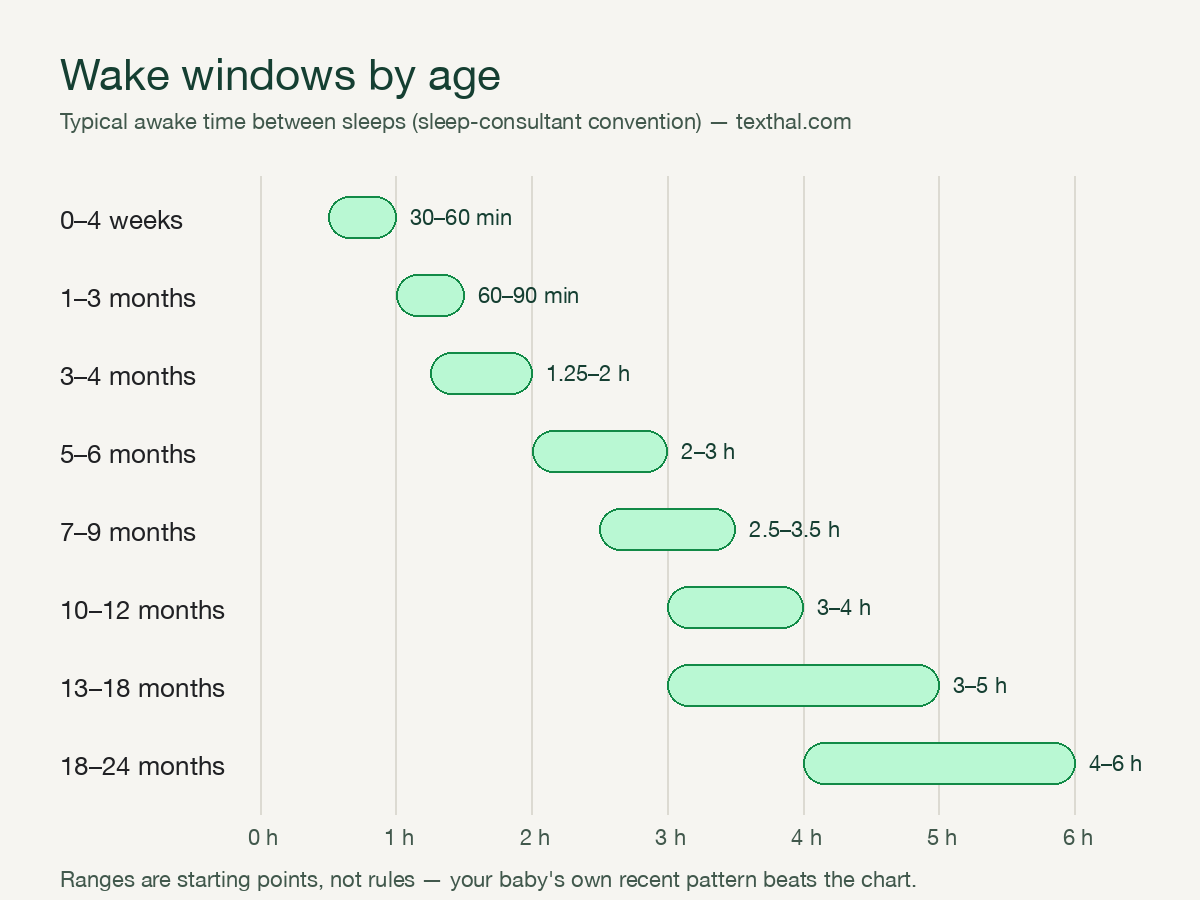
Put it on the fridge: download the printable chart (PDF) — same ranges, plus the four how-to rules, sized for one page.
For totals, which are formal medical guidance: the American Academy of Sleep Medicine (endorsed by the AAP) recommends 12–16 hours per 24 hours (including naps) for babies 4–12 months, and 11–14 hours for ages 1–2. There is no formal recommendation for newborns under 4 months — their sleep is too variable to standardize.
Prefer to skip the mental math? The free wake window calculator turns age + last wake-up into a next-nap time range.
How to use wake windows (without living by the clock)
- Count from wake-up, not from when you started trying. The window opens when baby actually wakes.
- Use the early end after short naps. A 30-minute catnap doesn't buy a full window.
- Watch the baby, then check the clock. Rubbing eyes, zoning out, fussing at toys — start wind-down. The chart tells you when to expect those cues.
- The last window of the day is usually the longest, and the first is often the shortest (a consultant convention, but an uncontested one).
Overtired vs. undertired
Both look like "won't sleep," which is why guessing fails — and short naps happen in both cases, so nap length alone won't tell you which. The distinguishing signal is mood and distress: an overtired baby is wired, cries hard at the crib, and wakes from short naps still cranky. An undertired baby resists calmly — plays or chats in the crib for a long time, settles late without drama, and wakes from a short nap cheerful. A common rule of thumb among sleep consultants: if you're seeing the first, shorten windows by 10–15 minutes and hold that for a few days; the second, stretch by the same amount.
Do wake windows include feeding time?
Yes. The wake window runs from the moment your baby wakes to the moment they're asleep again, and everything inside it counts — feeds, diaper changes, play, the wind-down. For newborns a feed can fill most of the window, which is why they're often ready to sleep right after eating.
When do wake windows start counting?
From wake-up, not from when you get baby out of the crib and not from the end of the feed. If she woke at 2:40 and you got her up at 3:00, the window opened at 2:40 — miss that and every estimate for the rest of the day runs 20 minutes late.
Should the last wake window of the day be the longest?
Usually, yes. Most babies handle their longest stretch of awake time right before bedtime, and the first window of the morning is typically the shortest. If bedtime is a nightly fight, the pre-bed window is the first one worth adjusting — often it's too short rather than too long.
The part no chart solves: everyone has to know today's timing
Wake windows only work if whoever is holding the baby knows when the last sleep ended. That's the actual hard part in a two-parent-plus-caregivers household. HAL solves it in the family group chat: anyone texts "woke 2:40" and everyone — including HAL's next-nap estimate from your baby's own recent rhythm — is looking at the same day.
Keep the schedule without keeping a spreadsheet
HAL tracks naps, feeds, and bedtime by text in your family group chat — no app, and every caregiver stays on today's actual timing.
Meet HAL →Sources
- American Academy of Sleep Medicine — Recommended Amount of Sleep for Pediatric Populations (consensus statement)
- AAP / HealthyChildren.org — Healthy Sleep Habits: How Many Hours Does Your Child Need?
- Cleveland Clinic — Wake Windows by Age (pediatrician-reviewed)
- Dr. Craig Canapari, Yale Pediatric Sleep Center — Do Wake Windows Help Kids Nap Better?
HAL is a household coordination and logging assistant, not a medical service. Sleep needs vary from baby to baby; the ranges here are common patterns, not prescriptions. Wake-window and nap-count ranges in particular are sleep-practitioner conventions rather than formal medical guidance — medical bodies publish only total-sleep recommendations. For health concerns, contact your pediatrician or another qualified professional.