Baby sleep schedules by age: 0–24 months
Baby sleep follows a surprisingly consistent arc: newborns sleep in fragments around the clock; by 4 months a real schedule emerges; naps consolidate from 4-ish to 3, to 2, to 1 by around 18 months. This page is the whole arc in one chart — with a deeper guide for every age when you need the details.
The master chart
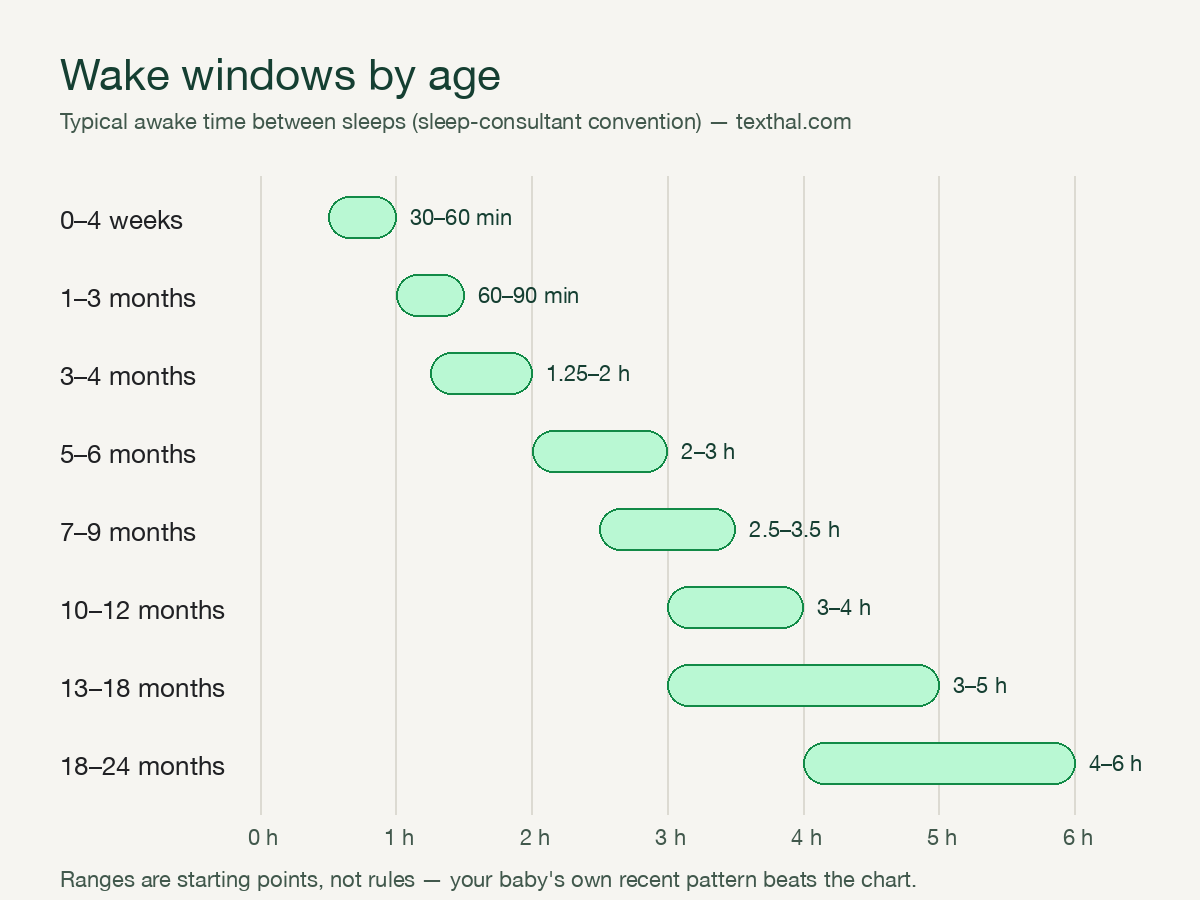
Nap counts and wake windows are sleep-practitioner convention (medical bodies publish only the totals — more on that below). Every baby drifts from these ranges sometimes; that's normal.
| Age | Naps | Wake windows | Day sleep | Night sleep | Total / 24 h |
|---|---|---|---|---|---|
| 0–3 months | 4–6+ (irregular) | 30–90 min | varies widely | fragmented | ~14–17 h |
| 3–4 months | 3–4 | 75 min–2 h | ~3.5–4.5 h | ~10–12 h | 12–16 h |
| 5–6 months | 3 | 2–3 h | ~2.5–4 h | ~11–12 h | 12–16 h |
| 7–9 months | 2–3 → 2 | 2.5–3.5 h | ~2–3.5 h | ~11–12 h | 12–16 h |
| 10–12 months | 2 | 3–4 h | ~2–3 h | ~11–12 h | 12–16 h |
| 13–18 months | 2 → 1 | 3–5 h | ~2–3 h | ~11 h | 11–14 h |
| 18–24 months | 1 | 4–6 h | ~1.5–2.5 h | ~11 h | 11–14 h |
How to read this chart honestly
Two different kinds of numbers live in that table. The totals are formal medical guidance: the American Academy of Sleep Medicine (endorsed by the AAP) recommends 12–16 hours per 24 for infants 4–12 months and 11–14 hours for ages 1–2, with no formal recommendation under 4 months. The nap counts and wake windows are convention from sleep practitioners — useful, broadly agreed, but not research-derived. Treat them as starting ranges and let your baby's own recent pattern be the tiebreaker. (More on this in the wake windows guide, or skip the math with the calculator.)
0–3 months: rhythm, not schedule
Newborns run on feed-sleep cycles of roughly 2–3 hours with wake windows so short (30–60 minutes at first) that a feed and a diaper change nearly fill them. Day/night confusion is standard-issue until the body clock consolidates around 6–12 weeks. Don't chase a schedule yet — build a repeatable cycle, keep days bright and nights boring, and follow safe-sleep rules for every sleep.
Full guide: newborn sleep, 0–3 months →
3–4 months: the schedule arrives (so does the regression)
Sleep reorganizes into adult-style cycles around 3–5 months — a permanent upgrade that temporarily wrecks nights (the famous 4-month regression). On the other side of it, most babies land on 3–4 naps with wake windows of 75 minutes to 2 hours, and the first genuinely predictable days appear.
Full guide: 4-month-old nap schedule →
5–6 months: the three-nap sweet spot
Two proper naps plus a late-afternoon catnap, wake windows around 2–3 hours, and solids joining the day. For many families this is the first stretch where tomorrow reliably looks like today.
Full guide: 6-month-old nap schedule →
7–9 months: the catnap goes
Somewhere around 7–9 months the third nap stops earning its keep. The two-nap day that replaces it — morning nap, afternoon nap, windows of 2.5–3.5 hours — is the most stable architecture of the first year. Expect a wobble around 8–10 months from separation anxiety and crawling practice.
Full guide: 9-month-old nap schedule →
10–12 months: two naps, and the fake-out
Still two naps for almost everyone — but around the first birthday many babies stage a convincing nap strike that looks like readiness for one nap and usually isn't. Hold the two-nap line through it.
Full guide: 12-month-old nap schedule →
13–18 months: the 2-to-1 transition
The real transition to one midday nap comes between 13 and 18 months, most commonly around 15. Done gradually — shifting the morning nap later in steps, bridging with early bedtimes — it takes two to four weeks.
Full guide: the 2-to-1 nap transition →
18–24 months: the one-nap era
One midday nap of 1.5–2.5 hours, wake windows of 4–6 hours, bedtime around 7–8. This architecture holds until the nap fades out entirely, typically sometime after age 3.
The three transitions at a glance
| Transition | Typical age | Tell-tale sign it's real |
|---|---|---|
| 4 → 3 naps | ~4–5 months | the fourth catnap keeps failing and bedtime holds anyway |
| 3 → 2 naps | ~7–9 months | the catnap pushes bedtime late or gets refused for weeks |
| 2 → 1 nap | ~13–18 months | a nap is consistently refused for 2+ weeks and skipped days go fine |
When do babies drop to one nap?
Most toddlers move to a single midday nap between 13 and 18 months, commonly around 15. Before ~13 months, nap refusal is far more likely a temporary strike than true readiness — the 2-to-1 guide covers how to tell the difference.
Should you wake a sleeping baby?
Sometimes. Wake a newborn if a feed is due and weight gain is still being established (your pediatrician will tell you). Wake an older baby to cap a nap that's threatening bedtime or running past the family's schedule. Otherwise, let sleep run — babies mostly take what they need.
Should bedtime move earlier when a nap gets skipped?
Yes — the early bedtime is the universal repair tool. Pull it forward by roughly 30–60 minutes (rarely before 6:00 PM) whenever the day's sleep came up short. It's much easier to protect a night than to rescue an overtired one.
The part the chart can't do: keeping everyone on it
A schedule only protects your baby if every caregiver runs the same one — and knows where today actually stands. That's the job HAL does in the family group chat: anyone texts "woke 2:40," everyone sees the same day, and the next-nap estimate comes from your baby's own recent rhythm rather than this chart. The chart is the map; the log is the GPS.
Keep the schedule without keeping a spreadsheet
HAL tracks naps, feeds, and bedtime by text in your family group chat — no app, and every caregiver stays on today's actual timing.
Meet HAL →Sources
- American Academy of Sleep Medicine — Recommended Amount of Sleep for Pediatric Populations (consensus statement)
- AAP / HealthyChildren.org — Healthy Sleep Habits: How Many Hours Does Your Child Need?
- Cleveland Clinic — Wake Windows by Age (pediatrician-reviewed)
- AAP / HealthyChildren.org — A Parent's Guide to Safe Sleep
HAL is a household coordination and logging assistant, not a medical service. Sleep needs vary from baby to baby; the ranges here are common patterns, not prescriptions. Wake-window and nap-count ranges in particular are sleep-practitioner conventions rather than formal medical guidance — medical bodies publish only total-sleep recommendations. For health concerns, contact your pediatrician or another qualified professional.